
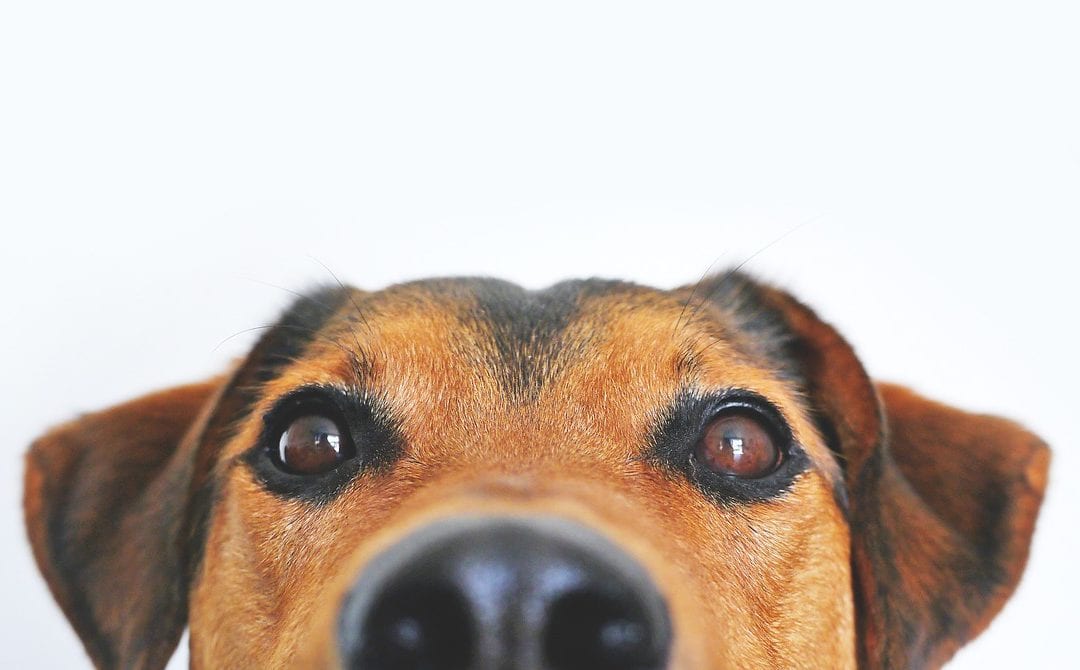
Although we can never truly know what a dog or cat is seeing, science gives us a lot of information on how their vision differs from ours. Pet owners often ask questions about the vision of their animals. Well here are the answers – or as much as science can tell us.
Color – It is an old wives tale that dogs and cats are color blind. They can see color, just not the same as we do. Humans have 3 types of cone cells in their retinas while dogs and cats only have 2. They can see the yellow-green spectrum and blue-violet spectrum well but lack the red-orange spectrum so these shades would appear brown-gray to them. If you are interested to see what the world may look like to them there are cell phone apps available to adjust the world to dog-vision.
Do dogs and cats see better than us? Well yes, and no. Their accommodation, or ability to focus is not as good as ours. This is why your dog may not be able to find a treat right in front of them until they sniff for it. Dogs and cats have a more highly developed sense of smell than us to make up for what they cannot see well. However, their ability to see motion, especially in dim light and at a distance is far superior to ours. Cats actually need 7 times less light than us to see and dogs about 5 times less.
Flicker Rate – This is the rate at which a blinking light appears at a continuous image. For people it is slower than dogs, so looking at a TV or computer screen which flickers 60 times per second it appears as a continuous image. Dogs and cats can process a higher flicker rate than us so they may look at the TV and see a strobe light effect.
Vision problems – Dogs and cats are prone vision problems just like us. They can be near-sighted, especially dogs, but adapt well to this through higher development of other senses. As they age, there are many causes for them to lose vision. Dogs can be prone to progressive retinal atrophy (PRA), cataracts and a variety of other conditions which may be limited to the eyes or related to systemic diseases. For cats that lose vision later in life high blood pressure complications from systemic diseases are more often the culprit. Dog owners often see their older dog develop foggy eyes and become concerned that it may be cataracts. Often the veterinarian can determine during the ophthalmic exam that it is actually a very common, benign, age-related condition called nuclear sclerosis, which luckily does not have much effect on vision. It is important to have this checked out and determine it is not cataracts since cataracts can cause inflammation, pain and glaucoma. If you think you are noticing vision changes in your pet it is important to have them checked out since many conditions that alter vision are caused by systemic diseases. A thorough examination of the eyes with an ophthalmoscope is part of every complete physical exam.